|
JOHANNES EICHEL � HESSIAN SOLDIER AND FATHER
by:
Brian Oickle (613-837-2887; email: [email protected]
I grew up in a small town of Bridgewater, Lunenburg County, Nova Scotia, Canada, astride the LaHave River (the Rhine of North America) approximately 15 miles inland from the Atlantic Ocean. Bridgewater was first settled in the late 1700�s and incorporated in 1899. The LaHave River Valley, since the 1630�s was a thriving centre of lumbering, milling, shipping and later, a railway centre. During the 1950�s and 1960�s, this was my home, where I benefited from loving parents, a solid middle class upbringing, the guidance of my Lutheran church, an outstanding school system (with a few flakey teachers, but that�s another story�) and an involved, progressive, self reliant community. Bridgewater, was an ideal cocoon for a young lad to prepare for the future; located on the LaHave River, 1 hour south of Halifax, near Lunenburg (the famous fishing seaport and home of the Bluenose schooner, Queen of the Atlantic, unbeaten in her racing career against the best from Gloucester, Mass.) and 20 minutes from the most gorgeous ocean beaches in North America. It never occurred to me that I was somehow �privileged� or �lucky� to have been raised there. The town was commercially successful and, with little or no government assistance, had constructed facilities that modern communities only dream about having available to their citizens. Picture this from the perspective of a 6 year old boy: a 1950�s town of 2500 people, with formal baseball diamonds with in-ground concrete dugouts and grandstands; a Tennis Club, with 6 clay courts, formed in 1889, the second oldest in Canada; a 6 sheet Curling Rink, established in 1907; (numerous Provincial Championships had been held at both the Tennis Club and the Curling Club); a 2000 seat indoor Hockey Rink; a racetrack for horse-sulky and car racing; a 9 hole Golf Course within the town limits; a Yacht Club 10 minutes outside the town on the LaHave River; 8 large permanent buildings dedicated to the annual, since 1891, 1 week Lunenburg County Exhibition which attracted in excess of 75000 people each year. Oh yes, there was something else�..there were lots and lots of Oickles in the town, and lots and lots of Eichels..�.of course we never saw anything special in the similarity of the two names because they were �just another family�. We lived amongst the other Lunenburg County founding families, such as the Arenburgs, the Zwickers, the Conrads, the Ernsts, the Veinots, the Boehners, the Langilles, the Rhodenizers, the Manthornes, the Wentzels, the Whynots, the Meisners, and so on�.all perfectly �normal� Nova Scotian names�. Then, in the 1980�s and 1990�s, Bridgewater, like most communities in North America, became fascinated with history and genealogy. Suddenly there were rumors�...maybe the Oickles and the Eichels were�.�related!?!? It took the arrival, and the investigative skills, of Harry Bishop Oikle, a retired professor from Queen�s University in Kingston Ontario, to lead us out of our collective misunderstandings of the past.
But before proceeding with the Eichel story, first, let me broaden the descriptive scope of the area where Bridgewater and Lunenburg are located, and take a brief look at the local history. Lunenburg County has a long European history, dating to the 1497 voyage of John Cabot, and the subsequent arrival of European fishermen who frequented the harbours of Nova Scotia. A century later, in 1604, when Pierre du Gua, Sieur de Mons and his cartographer, Samuel De Champlain arrived in Acadie (or, Acadia, covering most of today�s Nova Scotia, New Brunswick, Prince Edward Island and Maine) and mapped the LaHave area, now a village about 8 miles south of Bridgewater, named after the last point of land they saw when leaving France. De Mons later established a short-lived settlement on Ile St Croix (now part of Maine), before moving to Port Royal (near today�s Annapolis Royal), which was destroyed by Sir Samuel Argall of Virginia in 1613. In 1632, Isaac de Razilly, appointed Governor of Acadia by Louis XII, constructed Sainte- Marie-De-Gr�ce, a strategic fort and trading post near LaHave, which became the French capital of Acadia. For the next 100 years, England and France see-sawed in their domination of North America. The great French walled city of Louisburg (in Cape Breton) was captured in 1745 by New England volunteers under Commodore Warren, but in the 1748 Treaty of Aix-la-Chapelle, the British agreed to restore Louisburg to the French. England and France continued to covet Acadie, but the seminal event occurred in 1748, when Governor Shirley of Massachusetts was ordered by the English King to prepare a plan of civil government for Nova Scotia. It was accepted, and in May 1749, Colonel Edward Cornwallis was gazetted as Governor of Nova Scotia. He departed England 14 May 1749, with the sloop �Sphinx� and thirteen transport ships filled with +2000 settlers. By late June 1749, Cornwallis had established Halifax, and by May 1753, Governor Hopson, Cornwallis� successor, sent 1450 �Foreign Protestants� to settle in Lunenburg (formerly Merleguish, a small French settlement of 300 acres). Finally in 1758, the French city of Louisburg in Cape Breton was taken by the English under Major General Jeffrey Amherst, assisted by Colonel, later General, James Wolfe, who captured Quebec City in Sept 1759, delivering the North American continent, briefly, into British hands. Halifax was important to the British, to counterbalance the French Catholics (Acadians) already resident throughout the province. Lunenburg was populated with 1500 European Germans, French Huguenots and Swiss between 1750 and 1752.�
At the end of the American Revolutionary War, there was a great exodus out of the Thirteen Colonies. United Empire Loyalists, including Hessian soldiers in the employ of the British, all were desperate to leave the new country. Both Charleston and New York City became primary embarkation ports for the United Empire Loyalists, to escape the reprisals of the Continentals. These people had lost everything, but, where to go? England didn�t want them and they didn�t want England! Many went to Ontario, but this was a bit primitive and away from coastal travel. So, many found their way to Nova Scotia, also relatively primitive, but with a vast ocean coastline, it gave promise of easy reach of civilization. One group of Loyalists in New York called themselves the Port Roseway Association, who thought they could turn Roseway Bay on the south coast of Nova Scotia, into a city rivaling Charleston or New York. Roseway Bay, later Shelburne, with the help of the British military transports, became the fourth largest city in North America not long after the Revolutionary War. This glory lasted for about a decade, and the harsh land dispersed the settlers.�
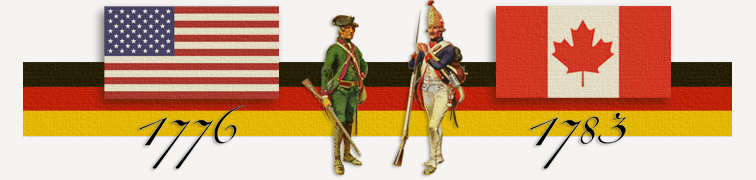
One German, a Hessian soldier, came to Lunenburg via Halifax from the British wars with the Americans; he is my ancestor, Johannes Eichel, who was married, and is buried, in Lunenburg. HETRINA (Hessisches Truppen im Amerikanischen Unabhangigkeitskreig, or, Hessian Troops in the American Revolution) lists the original German records of all soldiers from the principalities of Hesse-Cassel, Hesse-Hanau and Waldeck, records Johannes Eichel from Woelferbuett, Germany, a member of the Hesse-Cassel Jaegercorps, Company 4, and having �deserted� June 15, 1783.) Hessians continued to supplement the British forces stationed at Halifax, St John�s and Charlottetown in the 1770-80�s.
The genealogy of the Eichel family (which includes the variant spellings of Oickle, Oikle, Eikle, and Oicle) was prepared in the 1980�s and early 1990�s by Harry Bishop Oikle (deceased) of Cambridge Ontario. Copies of his genealogy are deposited with: the Nova Scotia Archives, Manuscript Division, 6016 University Avenue, Halifax, Nova Scotia B3H 1W4; and, in the office of the Southshore Genealogical Society, Box 901, Lunenburg, Nova Scotia B0J 2C0; and, in the office of the Shelburne Genealogical Society, Box 248, Shelburne, Nova Scotia B0T 1W0. Harry's 'Eichel genealogy' is 187 pages, plus a 21 page Alphabetic Index of Descendants, as well as a 9 page Alphabetic Index of Spouses.�
Harry Oikle was a meticulous researcher, having traveled throughout Ontario, Nova Scotia and the USA, to interview the descendents of Johannes Eichel. He also relied on the Canon Harris papers deposited in the Nova Scotia Archives in Halifax, as well as the Canadian Census records, and the records of many churches, including: St Paul's Anglican Church Mahone Bay, NS; the Dutch Reformed Church (later the Presbyterian Church), Lunenburg NS; Holy Trinity Anglican Church, Bridgewater NS; St Paul's Lutheran Church, Bridgewater NS; Christ Church Anglican, Shelburne NS.�
The Canon Harris papers record that "Johannes (John) Eichel was a native of Germany (born c. 1764 and died 1830) and a soldier in the British Army. After the American Revolutionary war, he was in North West (a village near Lunenburg) and then moved to Maitland. He was married in 1784 in Lunenburg to Mary Elizabeth Bouteiller. In later years he longed to see his old home in Germany. He was a good man to his grandchildren. He owned Lot # 28 North West which he sold to his son John for 50 pounds in 1810. John Jr. sold Lot # 29 North West in 1818 for 203 pounds." Johannes is buried in the St John's Cemetery (Anglican) Lunenburg, Nova Scotia. Harry Oikle's genealogy states that: "John Eichel came from Wolfenbuttel in the Province of Saxony in Germany. He was in the employ of the British Army and served in the Revolutionary War with the United States. In July 1783 John was in a military hospital in Halifax NS, and the German records show, in English, that he was 'found absent'. Other records show that he was listed as deserted from Hinrich's Company of the Hessian Chasseurs. At this time he was listed as nineteen years old. It may be speculated that he would have known there was a German community in Lunenburg and he found his way there. He was obviously accepted into the community and met a young lady there. In the records of the St John's Anglican Church, Lunenburg (built between 1753 and 1763), is listed the marriage of John Eichel and Mary Elizabeth Bouteiller, on August 29, 1784. Mary Elizabeth's family had come to Halifax in 1752 from the Principality of Montb�liard, (which became part of France in 1792; she was born in 1763, and died 1863, age 99 years, 10 months, 20 days). John acquired land in the Mahone Bay-Maitland area, near Lunenburg, and he and Mary raised their family there. John died Sept 13, 1830 and Mary died in 1863."
The children (and their birth/death dates) of John and Mary Eichel are:
...John...b. May 11, 1785....d. April 27, 1851(married Catherine Margaret Robar Dec 21,1803)
...(George) Frederick...b. Aug 4, 1787...d. Oct 1866 (called Fritz; married twice: Susanna�
Wynacht Dec 26,1809; and, Mrs. Marie Elizabeth Carver, a widow)
...Mary Elizabeth...b. June 19, 1789...d.? (married John Peter Lowe Dec 8, 1807)
...George...b. Nov 6, 1790....d. Mar 3, 1801
...Catherine Elizabeth...b. Nov 14, 1792...d. ? (married John Michael Morash in 1809)
...John Nicholas...b. Sept 6, 1795...d. Sept 30, 1837 (married Mary Magdalene Veinot 1817)�
...James Frederick...b. Sept 28, 1797...d. May 1868 (married Susannah Catherine Veinot July�
1822)
...Mary Catherine...b. Nov 20, 1799...d. March 16, 1801 of smallpox
... (John) Peter...b. Dec 17, 1801....d. ? (married Mary Sarah Barry Dec 1823)
...Mary Catherine...b. July 20, 1803... d. ? (married Frederick Robar June 4, 1822)
...Hanna Magdalene...b. Nov 22, 1805...d. ? (married George Christopher Veinot Jul 19, 1825�
who died in 1852; she then married Jacob Speidel
...George...b. Nov 2, 1808....d. April 24, 1826 (killed by a falling tree near Blystamer's Lake, North�
West Range)
...Paulus...b. Aug 14, 1810...d. Sept 3, 1847 (married Sophia Robar March 6, 1834)
My own line of connection to Johannes Eichel is:
...Johannes and Mary Eichel
...son John Eichel b.May 11, 1785...d. Apr 27, 1851
...his son Benjamin Eichel b. June 1, 1812 d. ? (married Mary Ann Croft Jan 26, 1843)
...his son Solomon Oikle b. Dec 3, 1844...d. ? (married Sophia Jodrey Aug 13, 1870; married�
Mary E. Corkum March 1885)
...his son Lawrence Garfield Oickle b. Mar 14 1882 d. Jan 1, 1963 (married Lottie Idella Whynot�
Apr 25, 1908)
...his son Irving Claremont Oickle b. June 2, 1913 d. Aug 28, 1984 (married Miriam Carolyn Bell�
Smith April 19, 1940)
...his son Brian Irving Oickle b. Oct 5, 1945 (married Paulette Diane Arenburg May 11, 1968)
...1. my son Kevin Brian Oickle b. June 9, 1972 (married Jennifer Wales Sept 6, 1998;�
His children: Katherine b. April 10, 2001; and Nathan b. Feb 5, 2003)
...2. my son Lorne Reid Oickle b. Oct 29, 1973 (married Krista Matthews Oct 9, 1999;�
His children: twins Devon and Ethan b. Jan 26, 2002; and, Justin b. May 24, 2005)�
In the mid 1990�s, I was in Salt Lake City on a business trip, and decided to view the famous Mormon Tabernacle. While there, I came upon their genealogy centre and took time to use their computers. To my great surprise, a number of Oickle names, all resident in the USA, started to appear. It seems that branches of the Johannes Eichel family are well established across North America!
I hope this is a helpful overview of the Johannes Eichel (Oickle, Eikle, Oikle, Oicle ) family and that it provides useful material for future researchers.
Regards,
Brian Oickle (613-837-2887; email: [email protected])
References and Bibliography:
�.....Folklore of Lunenburg County, Nova Scotia by Helen Creighton (National Museum of�
Canada, Bulletin No. 117, 1950)
........The "Foreign Protestants" and the Settlement of Nova Scotia by Winthrop P. Bell�
(Acadiensis Press, Mount Allison University, 1961)
........History of the County of Lunenburg by Judge Mather Byles DesBrisay 1895 (Canadiana�
Reprint Series No. 35; Mika Publishing Co. Belleville Ontario 1980)
��..Historic LaHave River Valley, by S. Chambers, J. Dawson, E. Wolter (Nimbus 2004)�
�....Matthias and Jacob Conrad by Scott W. Teal, 1988 (private printing)
��.South Shore: Seasoned Timbers, volume 1 & 2, Heritage Trust of Nova Scotia, 1974
��.A Walk Through Old Lunenburg, by The Lunenburg Heritage Society, 1979
��.The Rising Village: Chapters in the History of Petite Riviere, Nova Scotia, by Malcom Parks,�
1998
��.The History of New France, by Marc Lescarbot, Paris 1609 (English translation edited by�
W.L.Grant, Toronto Champlain Society, 1907-14)
��..Historic Saga of LeH�ve (LaHave) by Ruth Kaulback 1970
��..LaHave in the Late Seventeenth Century by Joan Dawson, Nova Scotia Historical Review,�
Volume 2, number 2, 1982
��..Fort Sainte-Marie-de-Grace, LaHave Nova Scotia: 350 Years of History, Ibid
��..Loyalists and Layabouts: The Rapid Rise and Faster Fall of Shelbourne, Nova Scotia,�
1783-1792 by Stephen Kimber, Doubleday ( Globe and Mail Book Review, July 19,�
2008, by Marc de Villiers)
��..The Atlantic Region to Confederation- A History, edited by P.A. Buckner & J.G.Reid
�.....Obituary notices from NS weekly newspapers were a rich source for Harry Oikle to find�
descendants of Johannes Eichel, and, he traced descendants through family histories.
��German church records at Evangelisches Pfarramt in Wolferbuett
|